Showing posts with label kingship. Show all posts

Saturday, September 29, 2012

Comps Installment 1

It is the start of a new semester. Actually, we are already a few weeks in. I've been devoting the last few weeks to shoring up one of my comps lists on the Early Modern English History Play. So the blog has been a bit quiet of reading responses. I'll be adding a reading response post over the weekend or early next week on some of the Henry VI's, but in the meantime I'd like to share how this list is shaping up.

Shakespeare really corners the market of the English history play. He tops my list by more than ten to one, if we also include those he likely co-authored. I'm excited to be able to order some of these texts on Amazon and others I have access to via EEBO (Early English Books Online).

Shakespeare, William.
1 Henry VI2 Henry VI3 Henry VIRichard IIIRichard II1 Henry IV2 Henry IVHenry VHenry VIIIKing John
And the plays that have been engulfed in the authorship debate lately:
Edward III (New Cambridge Shakespeare)Sir Thomas More (Arden Shakespeare)
And in the firmly, non-Shakespeare camp:
Marlowe, Christoper. Edward II.Ford, John. Perkin Warbeck.Heywood, Thomas. The First and Second Parts of King Edward IV. (EEBO / Revels Plays)
Peele, George. Edward I (c. 1591) (EEBO)
Anonymous. The True Chronicle History of King Leir. (c. 1590)
--. Famous Victories of Henry V.--. Thomas of Woodstock. (Revels Plays)
I'm a little on the fence about including King Leir, but it is billed as a "True Chronicle History" so it seems worth it to have on there at the moment. I can always delete it later on.

I'm really intrigued by adding the following series of poems to my list. Although they don't fit neatly into the category of "history play," it seems clear that they were influential to many of the plays written in this period.
Baldwin, William et al. Mirror for Magistrates. (EEBO)
Since I am also focusing on performance in my dissertation, I have acquired a few of the following already. Some are films, some are filmed stage productions, some I have yet to find but am hoping they are available.
The Hollow Crown. Dir. Richard Eyre and Rupert Goold. BBC, 2012. 
The Wars of the Roses. Perf. Michael Pennington. BBC and English Shakespeare Company, 1989. 
Wars of the Roses. Dir. John Barton and Peter Hall. Perf. David Warner and Ian Holm. Royal Shakespeare Company, 1965.
An Age of Kings. Perf. Robert Hardy, Sean Connery, and Judi Dench. BBC Worldwide, 2009.
Edward II. Dir. Derek Jarman. Perf. Steven Waddington, Kevin Collings, and Andrew Tiernan. Sales Company, 1991. 
Edward II. Dir. Richard Marquand and Tony Robertson. Perf. Ian McKellen and James Laurenson. BBC Worldwide, 2009. 
Richard II. Dir. William Woodman. Perf. David Birney. Bard Productions Ltd., 1982. (Just ordered on eBay!)
I know there is also a 1971 production with Ian McKellen as Richard II, but I have not been able to track that down anywhere. I also believe I found some copies of the NBC Hallmark Hall of Fame TV production (1954) starring Maurice Evans. University of Delaware, UT Austin and UC Berkeley libraries have copies according to worldcat.org. I also think I can get a copy of the 1997 production of Richard II starring Fiona Shaw at the NYPL. Included in the BBC Complete Shakespeare Collection should be the 1978 Richard II with Derek Jacobi as Richard. If so, I'll be ordering that on eBay as well.

We're going to need a bigger bookshelf.


Friday, March 23, 2012

Law and Justice {week 8 response}

In working towards my final paper, I've begun compiling an annotated bibliography. There are piles of books everywhere, and I just invested in a file box to keep all the article print-outs and photocopied chapters. I'm trying to balance research, reading, and writing in these last few weeks of the semester so that my seminar paper won't be a complete nightmare on May 4!

In the interest of balance, therefore, I've done some free-writing on "The quality of mercy" from Merchant with some pointed questions at the end thinking towards 2 Henry VI.

***********************


On a simplistic level, in the quality of mercy speech, the text is pitting the notions of mercy and justice against each other. They feel at first like opposites, but they are not entirely mutually exclusive concepts. Although Portia suggests that if we proceed exclusively “in the course of Justice”,  mercy is not possible, she also suggests that it is indeed possible, even desirable, for mercy to attenuate justice: “when mercy seasons Justice” (IV.i.195). This is after all what she is arguing.
Mercy also is seated in a power relationship. Mercy is offered to and begged by those in a position of weakness. Antonio hopes for mercy; he is entirely in Shylock’s power. Portia acknowledges this relationship: “‘Tis mightiest in the mightiest” (186). Those who can offer mercy have power over those who seek it. Mercy is most powerful in the hands of the most powerful. It places spiritual power in the hands of those who already possess earthly power, most notably, of course, “The throned Monarch.” Mercy is the prerogative of kings, or rather when kings exercise mercy it has a more powerful effect than when a commoner does. Perhaps Portia hopes to sway Shylock with this idea of kingly power?
In this speech, Portia clearly argues for the preeminence of mercy. It is above all the other symbols of power the king possesses: his crown and scepter: “But mercy is above this scepter’d sway” (191). Although crown and scepter are the visible symbols which identify the king’s position and power, they are less significant. If the king shows mercy, he shows himself to be beyond “temporal power” (188) and more “likest God’s” (194). A crown, a scepter, a throne, awe, majesty, dread, and fear are also subject to the power of the divine, which is specifically identified not with Justice but with mercy.
It is worth noting that Portia herself does not take on the power of distributing mercy. She deflects it to the Duke -- the seated monarchical power in Venice. “Down and beg mercy of the duke.” Antonio becomes conflated in this position as well since Shylock’s wealth is to be split between the treasury of Venice (represented by the Duke) and Antonio. This is where I become frustrated by arguments of Portia’s “con.” I don’t see her as acting entirely out of self-interest. If she were, she could take Bassanio’s suggestion that she “Wrest once the Law to your authority” (213). The law must take precedence. Portia is here, then, identified with the law. The law itself is identified with justice. Mercy is seated in the human (divine?) figure of the monarch. If Portia speaks for the law, then mercy is not her prerogative.
Looking to the early histories (2 Henry VI in particular), what then do we see as the king’s relationship to the law? In the courtroom of Merchant, the figure of Portia seems to separate the voice of the law from the voice of mercy, which is the voice of the monarch. The voice of King Henry VI, however, is weak. He seems strongest when banishing Suffolk (unmercifully?), yet this is at the force of Warwick and the commons. What is the king’s relationship with justice and equity? Is he unjust in the hearing of accusations against Gloster? Is he just in his banishment of Suffolk? Where does Henry exercise mercy? Although it feels like he preaches it, where does he enact it?

**Line numbers are from Bevington, Complete Works, 4th edition. Capitalizations are preserved from First Folio.

Monday, March 19, 2012

Kingship Cycle Auditions


Kingship Cycle Audition Announcement
Adirondack Shakespeare Company will be holding auditions for the 2012-2013 Kingship Cycle on Sunday, April 1 and Monday, May 14 at CAP21 Studios (18 W 18th Street, NYC). Please email a headshot and resume to casting@adkshakes.org if you are interested in being seen.
The Kingship Cycle is a two-part project. The first half will take place in the fall of 2012 and includes productions of 1 Henry VI, 2 Henry VI, 3 Henry VI, and Richard III. We are seeking a company of 12 actors for this project. The second half will take place in the spring of 2013 and includes productions of Richard II, 1 Henry IV, 2 Henry IV, and Henry V, for which we are also seeking a company of 12 actors. These auditions will consist of readings from all eight plays. Auditions held on April 1will consist mostly of readings from Part 1 of the Cycle. Auditions held on May 14 will consist of readings from Part 2 of the Cycle.
Dates for this project are tentatively set for October 18 - November 17, 2012 for Kingship Part 1 (1 Henry VI, 2 Henry VI, 3 Henry VI, and Richard III) and for March 28 - April 27, 2013 for Kingship Part 2 (Richard II, 1 Henry IV, 2 Henry IV, and Henry V). Rehearsals and performances will take place on both the Queens and Manhattan campuses of St. John’s University.
Please note that for roles spanning multiple plays (Richard III, Prince Hal, Margaret, for example), one actor will be cast to play the same role across each of the plays in which this character appears. The idea of these productions is to create as clear a through-line as possible for the story, the characters, and the ultimate question of this project: What makes a (good/bad) king? The culmination of this project will be my doctoral dissertation in English Literature, which will focus on the text of the plays as literature, but also on elements of theatrical performance and original practice-influenced production.
We will be casting a company of 12 actors for each Kingship Part. This means there will be a cast of 12 actors for Kingship Part 1 (1, 2, 3 Henry VI and Richard III). Actors will also be considered for Kingship Part 2 (Richard II, 1 & 2 Henry IV, and Henry V). Each contract represents a commitment for the four shows within each Kingship Part. Casting in one Part does not guarantee casting in the other.
Auditions on Sunday, April 1 and Monday, May 14 will held in groups of 8-10. Each group session will last one hour and consist entirely of cold readings from the plays. If you have not auditioned for the company in the past, we will ask you to present a prepared monologue (1-2 minutes in length, classical verse ONLY).
This project differs from past Shakespeare IN THE RAW productions in that it will include several workshop rehearsals prior to the shortened, intensive rehearsal period (which is comprised of approximately 12 hours of rehearsal per production). These workshops will incorporate movement, text analysis, and discussions of political, social, and historical context for these plays. I anticipate a series of three to five workshops (one per week) in the weeks preceding the opening dates listed above. Read-throughs will also take place several weeks in advance of the rehearsal and performance dates listed above.
Our intensive rehearsal period will consist of a speak-through of the entire text of each play; small group scene work focusing almost entirely on text; working through any music and/or violence; and a final cue-to-cue of each play. The cue-to-cue is the last portion of rehearsal, in which we work entrances, exits, music, violence, and any tricky staging. There is no run-through of the show prior to performance. I’ll say that again -- the very first time we run through the play is in the first performance.
All company members must arrive for the first rehearsal on fully memorized and able to run through all of their assigned roles off-book.  Preparation is a crucial element to this process, so please consider your ability to dedicate ample time ahead of the performance weekend when determining your availability. With only 12 hours of rehearsal for each play, there is no time to dedicate to learning your lines.
Company members must have a high degree of comfort with the mechanics and musicality of verse-speaking.  
All roles are paid. Non-Equity contracts only.

Tuesday, March 13, 2012

Same Name Syndrome

I'm working through editing and re-setting the scripts for the first tetralogy of The Kingship Cycle, and last night was devoted to 3 Henry VI. Luckily, this script is in really good shape. I fixed a few typos and reset the character names. King Henry VI is sometimes set as "Henry" and sometimes as "King." King Edward IV - same thing. But there's also Prince Edward, son of Henry VI, who fortunately is usually set as Prince.

Throughout these 8 history plays, the characters have good, strong English names. How are we supposed to keep them straight?

My approximate count (since I'm certain to be missing at least a few) is:
  • 7 Henrys
  • 6 Edwards (technically Edward III and the Black Prince of Wales are only mentioned)
  • 4 Richards
  • 4 Edmunds
  • 2 Humphreys
  • 1 George
  • 8 Johns
  • 3 Thomases
  • By the time I got to William, I gave up.

I finally feel after having performed in 5 of these 8 plays in the past, seen films and theatrical productions, read them multiple times like I can begin to keep many of these names straight with titles. How do I make this easier on an audience member who perhaps has never seen 1 Henry IV? Or an actor who is familiar with Richard III but not 2 Henry VI? Maybe I should invest in a wall poster on the genealogy of England's Royal Houses.

Monday, March 12, 2012

King-Sized To Do List

The preparation for The Kingship Cycle is occasionally overwhelming. This is the largest project that ADK Shakes has undertaken to date, so there's a lot to keep up with. I really enjoy writing posts about what is taking place behind the scenes on all our projects, so here's a look at the many things going on right now in order to prepare for next fall and spring's two-part Kingship Cycle.

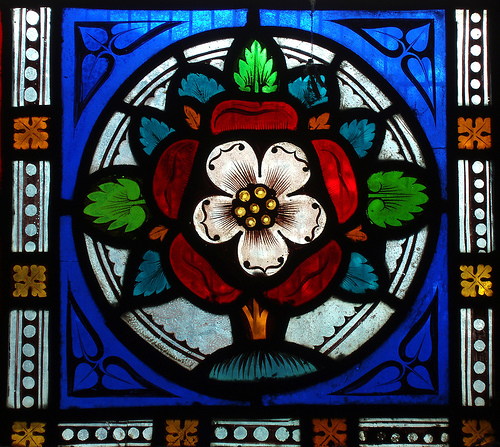
Tudor Rose Window. Source.
  • Character Maps

Also known as "French Scenes," these maps track each character's trajectory throughout the course of the play. This helps me build Character Tracks to assign to each individual actor, as I can see how the roles can conceivably double up. Luckily, since we have already produced 1, 2, 3 Henry VI and Richard III, we already have maps for these shows complete. I reorganized the doubles based on the concept for this project, but I didn't have to start from scratch. Henry V is also already complete, and we just finished Richard II yesterday.
To Do: 1 & 2 Henry IV

  • Casting Matrix

You can view the Casting Matrix for the first part of The Kingship Cycle and get an idea for how complex this project is! I have only just begun the Matrix for Part Two, but I won't be able to complete it without the aforementioned Character Maps. What makes this project particularly difficult to map is that I want individual actors to follow a character through multiple plays. For example, Falstaff appears in 1 & 2 Henry IV, and therefore the same actor will play Falstaff in both plays. Exciting stuff! But it can be messy when building the Matrix. I learned last weekend that it's better to start from the end and work backwards. The Richmond / Edward double in Richard III is clear from the Map, so that meant Edward and Richmond double in 3 Henry VI. OK, no problem, but where I had Edward placed in 2 Henry VI (in which he speaks only 1 line) didn't work at all. I had to unravel and re-do the Matrix three plays back. Now I know! I will start from Henry V and work backward!
To Do: R2-HV Matrix

  • Scripts

When Patrick and I prepare scripts for performance, we begin with the First Folio. I love the Applause texts of the individual plays. Neil Freeman's notes are terrific. He marks alterations between the various Folio and Quarto texts and describes in detail the changes that appear in each iteration. In our scripts, we preserve First Folio capitalizations and punctuation always, and spelling sometimes. Decisions on alterations to the line are discretionary, and sometimes I will make a note in our script so an actor can see the change and make the decision for themselves. Here's a peek into how different the versions can be. When we first started producing Shakespeare IN THE RAW, though, we had not yet developed this method. So our early scripts are ... well ... kind of a hot mess. I'm currently going through and re-setting the format, fixing typographical errors, and adding footnotes. I won't lie, it's kind of tedious. And there's a giant ticking clock ... the actors are going to need these scripts just as soon as possible. The actor who will be playing Richard III will have approximately 1900 lines to learn. To put that in perspective, an uncut Hamlet speaks 1476 lines. Yeah! What?!?
To Do: Formatting and editing for 1 Henry VI. Light editing for 3 Henry VI and Richard III.
Footnotes for 1, 2, 3 Henry VI, Richard III, Henry V
Everything (!) for Richard II, 1 & 2 Henry IV

  • Auditions

Right! I have to cast these shows! Because the actors playing Richard III and Henry V in particular have such a massive line load, I need to cast and get these scripts out so they have time to actually learn all these lines and prepare these intricate characters. That means auditions have to happen soon! So -- any actors reading this blog, this is for you! -- I'm planning to hold auditions for Part 1 of The Kingship Cycle on Sunday, April 1 and for Part 2 of The Kingship Cycle on Monday, May 14. You can send me your interest at casting@adkshakes.org now, but I'll also be emailing a notice to our Actor Mailing List. (If you're not on that and you want to be, email info@adkshakes.org.)
To Do: Actor Info Sheets and Sides from all eight plays.

  • Calendar

We have come up with a schedule for these rehearsals and performances. It's intense, and I love it! I'm planning a series of weekly workshops leading up to our intensive Shakespeare IN THE RAW style of rehearsal and performance. These workshops will include read-throughs, movement rehearsals, discussions on the genealogy, history, and socio-political issues in the plays. The rehearsals will be set up to put up two plays over the course of a weekend (as we have done in the past with the Bookend and Justice Projects) and then perform the same two plays the following weekend. Weeks 3 and 4 will be putting up and performing (twice each) the second two plays. And Week 5 (my favorite!) will be a marathon of all four plays. This week we have a meeting to ensure that we can hopefully get the specific dates we are looking at -- keep your fingers crossed!
To Do: Reserve all dates for workshops, rehearsals, and performances.

  • Research

This is just an ongoing piece of the puzzle. I am fortunate to be doing a portion of this work as my directed research for the spring semester. It's fascinating reading, and it's great exercise for my brain. I can't wait to dig into more reading on the law and history of the period. I'm swimming around in the first tetralogy of plays right now and also looking forward to diving into the second tetralogy.

Even though this To Do List is big and long and complicated, it's a wonderful feeling to realize that there's nothing else I'd rather be doing.

Sunday, March 11, 2012

Reading List

Since heading back to school last year, I've noticed that I have developed a pretty consistent trend over the course of the semester. I start out reading like crazy (which never really lets up), and perhaps I also have an overarching idea that I'm interested in pursuing throughout the class (which sometimes changes drastically). Around midterms (usually just after I've written my midterm paper), I start researching with my final paper in mind. I've read around enough to have a good (if sometimes basic) idea of what's out there, or at least where I should start looking. And I've refined my "overarching idea" enough to make a final paper out of it.

That's about where I am right now in my Emergence of Modernism class and in my directed research. I spent most of Friday trolling library online catalogs and databases. I've got a list of books to pick up and a pile of articles in my downloads folder to sift through - exciting! I'm working towards writing on the legal notion of equity and its historical place as the purview of the monarch. It's the perfect marriage between The Justice Project and the beginnings of The Kingship Cycle. I still have to do the legal part of the research, so I'm hoping for some help researching on West Law and Lexis Nexis. Here are a few of the titles on my reading list:

Law and Empire in English Renaissance Literature by Brian C. Lockey

Rhetoric and Law in Early Modern Europe by Victoria Kahn

The Poetics of English Nationhood, 1590-1612 by Claire McEachern

Shakespeare and the Legal Imagination by Ian Ward

Treason by Words: Literature, Law, and Rebellion in Shakespeare's England by Rebecca Lemon

Metadrama in Shakespeare's Henriad by James Calderwood

Forms of Nationhood by Richard Helgerson

I'd better put some tea on and get reading!

Thursday, March 8, 2012

Law and Justice {week 6 response}

It is post-Spring Break. I have finally recovered from two sinus infections and two Shakespeare IN THE RAW productions. It is time to get back on track with my reading responses.

I am a bit sad and a bit nostalgic to leave behind The Merchant of Venice and Measure for Measure, but I am also feeling invigorated to completely switch gears to the early history plays. I have a much larger question in mind for my dissertation project of The Kingship Cycle (Part 1, Fall 2012: 1, 2, 3 Henry VI and Richard III and Part 2, Spring 2013: Richard II, 1 & 2 Henry VI, and Henry V) about the education of a king. Looking for questions of law, equity, and justice feels like a good basis for this.

This week I've been focusing my reading on 1 & 2 Henry VI. I'm interested in the legality of Richard Plantagenet, Duke of York's claim to the English throne over our titular king of these plays, Henry VI. Throughout these Big 8 history plays is the lingering of question of legal succession to the throne. In order to make some semblance of sense of the line of succession:

Edward III (incredibly fertile)
||
Richard II (deposed)
||
Henry IV ("usurps")
||
Henry V (succeeds)
||
Henry VI (succeeds at 9 months old)
||
Richard, Duke of York
(claims throne according to descent from Lionel, Duke of Clarence,* never crowned)
||
Edward IV (son of Richard, Duke of York)
||
Edward V (never crowned, deposed)
(one of the famous Princes in the Tower allegedly murdered by Richard III)
||
Richard III

This is possibly the most simplistic and rudely basic line of succession that I can draw in a blog post without proper tools.

* Here's what I want to be more specific about. The claim actually proceeds from before Richard II. Edward III had seven sons. His eldest son (also named Edward and more famously known as the Black Prince of Wales) would have succeeded Edward III, but died. His son Richard succeeds as king. But because Richard II is #1) usurped and #2) dies without heirs, the claims to the throne following are messy (to put it lightly).

Henry IV descends from Edward III's fourth son, John of Gaunt, the Duke of Lancaster. Richard Plantagenet, Duke of York and his son Edward IV claim the throne through Edward III's third son, Lionel, Duke of Clarence:
YORK  The third Son, Duke of Clarence, 
              From whose line I claim the Crown, 
              Had Issue Philippe, a Daughter,
              Who married Edmond Mortimer, Earl of March:
              Edmund had Issue, Roger, Earl of March;
              Roger had Issue, Edmund, Anne, and Elianor. 
SALISBURY This Edmund, in the Reign of Bolingbroke,
              As I have read, laid claim unto the Crown,
              And but for Owen Glendower, had been King;
              Who kept him in Captivity, till he died.
              But to the rest.
 
YORK                         His eldest sister, Anne,
              My Mother, being Heir unto the Crown,
              Married Richard, Earl of Cambridge, 
              Who was to Edmund Langley, 
              Edward the third’s fifth Son’s Son;
              By her I claim the Kingdom:
              She was Heir to Roger, Earl of March, 
              Who was the Son of Edmond Mortimer, 
              Who married Philippe, sole Daughter 
              Unto Lionel, Duke of Clarence.
              So, if the Issue of the elder Son
              Succeed before the younger, I am King. 
WARWICK What plain proceedings is more plain than this?
              Henry doth claim the Crown from John of Gaunt,
              The fourth Son, York claims it from the third: (II.ii)
This excerpt is taken from ADK Shakespeare's prepared performance script, based on First Folio.

York's argument convinces Warwick and Salisbury. Is it supposed to convince the reader/the audience? The average audience member of Shakespeare's day would certainly have a greater level of familiarity with the line of British kings than today's average American audience member. The claim is filled with such intricacies, twists and turns, that Shakespeare no doubt thought his average audience member would not perfectly follow this history. Warwick's response, "What plain proceedings is more plain than this?" aims for (and likely receives) a hearty chuckle. Of course, these proceedings are far from plain! Warwick then reduces the claim to the more digestible germ: Henry VI claims "the Crown from John of Gaunt, / The fourth son, York claims it from the third". Insert collective "Oh!" here.

The basis of York's argument is a legal one. His claim must be legal if he hopes to have full support. My question is what kind of law and legality do we have in these plays (specifically 1 & 2 Henry VI, but even more broadly through 3 Henry VI and Richard III too)? Do we have strict readings of the law such as Angelo and Shylock respectively advocate in Measure and Merchant? Or are these technicalities, such as what Portia finds in the bond? Or are either of Henry VI's and York's respective claims to the crown too liberally interpreted?

So much of what I am reading is clearly setting up events-to-come. What I want to look for as I continue to read:
  • the legality of establishing a claim to kingship
  • the contrast of liberty / justice (like what we saw in Measure and Merchant)
  • who is interpreting law and how? And whose side is the play on?

Monday, February 20, 2012

Law and Justice {belated Week 4 response}

With the successful closing of The Justice Project this past weekend, it is time to re-focus my energies on text, on reading and writing. I've been very wrapped up in production, but I hope the productions will sharpen my readings on Merchant and Measure.

The mid-term of the semester is almost here, so I'm hoping this week to have a potential germ for my final paper. Thus far, I've been doing a lot of thinking about the character of Portia, but I'm not sure that I want to continue this train of thought through for the rest of the semester. In performance, I played Portia in Merchant and also doubled as Escalus in Measure. This double was really fascinating, as Escalus acts as judge in the majority of his scenes in the play. Perhaps I'll want to draw out the connection of these two characters?

I am also interested, however, in the second half of this semester's reading as I move into some of the political plays. In "The quality of mercy," Portia talks of the power of kings on earth, and this seems to me a good jumping-off point for reading these early history plays. How do we see "earthly power" played out in the Henriad plays and in Richard III? Portia speaks abstractly of "the mightiest," but in the history plays that's who we spend our time with. What should the "throned Monarch" do with these concepts of law, justice, and equity (or mercy) that we've spent so much time thinking about and staging in The Justice Project?

Wednesday, October 12, 2011

Kings as epic heroes, heroes of tragedy

For my Theory of the Novel class, I'm reading some excerpts by Georg Lukacs and came across this snippet which jumped out at me:
Epic heroes have to be kings for different reasons from the heroes of tragedy (although these reasons are also formal). In tragedy the hero must be a king simply because of the need to sweep all the petty causalities of life from the ontological path of destiny -- because the socially dominant figure is the only one whose conflicts, while retaining the sensuous illusion of a symbolic existence, grow solely out of the tragic problem; because only such a figure can be surrounded, even as to the forms of its external appearance, with the required atmosphere of significant isolation. (192)
No time to really do any thinking on the screen here about this quotation, but I didn't want it to get lost in my giant book. So I'm tagging it in a post here for later consumption.

Just curious -- anyone else out there using scholarly blogs for note-taking on larger research projects?

Above quote excerpted from The Theory of the Novel: A Historico-Philosophical Essay on the Forms of Great Epic Literature. in Theory of the Novel: A Historical Approach, ed. Michael McKeon. John Hopkins University Press, 2000.

Tuesday, September 6, 2011

King Coffees: Richard II

Possibly my favorite speech from R2.
This morning I met my friend Collin for a "King Coffee." We are both really excited about the Kingship Cycle and just having a great time talking through the Big 8. At our last King Coffee, we came at the whole project, but today we focused just on Richard II.

I. love. this. play. It's been probably about eight years since I last read it. What an absolute joy to come back to it -- and no longer as a junior in college with little-to-no background in English history, little-to-no experience acting Shakespeare, (come on, let's face it) little-to-no experience whatsoever. Since then, however, I have acted in 1, 2, 3 Henry VI, Henry V, and Richard III. So I know the personnel in these plays now. No simple feat. And well ... just having lived a little bit of life changes the way you read a play. I'm a completely different person than I was eight years ago. Thank goodness.

Anyway. Armed with sticky notes, highlighters, multi-colored pens, and iced coffee -- Collin and I sat down to get any kind of handle on this play whatsoever. Here are some of the things I was interested in (as indicated by blue, green, and yellow sticky notes):

  • the abilities of the king. What is able to do? What are the things he is incapable of doing? (These started out as blue sticky notes, which ended up becoming a little more general and inclusive mentions of 'kingship.')
  • the death or downfall of kings (green sticky notes). The dichotomy of high/low is, of course, incredibly pronounced in this play. Great concerns with high ambitions, lofty thoughts, the heavens, the association of the king with the divine/height. And how far a king has to fall, to "come down," the earth, baseness, the common people.
  • England, the realm, the nation. (yellow stickies) This ties into the body politic, how the body of the king embodies the nation.
There are so many passages that interested me in this play, but one that particularly jumped out at me is in the above photo: "throw away Respect, / Tradition, Forme, and Ceremonious dutie, / for you have but mistooke me all this while" (3.2.175-7). Without these things, Richard argues he is not a king. He becomes a common man, as other men are. This speaks all the way across to Henry V's monologue on "ceremony" and kingship. But I get a little ahead of myself! Shakespeare introduces here in R2 how we might think of kings and common men. Let's see how it unravels next in 1 Henry IV.

Saturday, September 3, 2011

The Body Natural and The Body Politic

Last night I finished the first two chapters of The King's Two Bodies by Ernst H. Kantorowicz, which were on Plowden's Reports and Shakespeare's Richard II. My first conclusion is that I need to learn Latin for my foreign language requirement. (Even though I took three years of Latin in high school, it's not enough to be useful to me anymore. Oh, high school.) My second conclusion is that I can't wait to reread Richard II with this very thought in mind, that a king possesses within his own person two identities, or bodies. Yes, it's so obvious from the title, I know. But here's the argument in a bit more detail.

A king (lowercase 'k') has his "body natural," his physical, frail, mortal, human body. This body is subject to aches and pains and diseases and old age and eventually death. Once he is crowned King (uppercase 'K'), he gets an added bonus. He takes on a "body politic" and becomes the body of the realm.

What's important about Edmund Plowden's Reports is that he collects and expounds on the legal argument behind the king's two bodies, which is an older more medieval and mystical concept and not one cooked up in Plowden's day. (PS - You can get Volume 1 of Plowden's Commentaries or Reports free on Google Books. I love Google Books.) The Elizabethan culture was clearly concerned with legal questions of kingship, how do we define it, how do we define the body of a king -- or queen, for that matter, how do we deal with the assumption that a king's body is different from that of a common man. These questions are not just tackled in medieval and renaissance courts, but the very questions tackled in Shakespeare's history plays.

Plowden was 46 years old when Shakespeare was born, so they were not of the same generation. Shakespeare would likely have been familiar with Plowden's work though, given his own interest in the law and activity in the English courts. Kantorowicz pulls several passages from Richard II to show how Shakespeare is thinking in terms of the king's two bodies through the character of Richard. Here's a snippet from Plowden's Reports which opens up both The King's Two Bodies and Richard II, and I can't wait to dig in further.

For the King has in him two Bodies, a Body natural, and a Body politic. His Body natural (if it be considered in itself) is a Body mortal, subject to all Infirmities that come by Nature or Accident, to the Imbecility of Infancy or old Age, and to the like Defects that happen to the natural Bodies of other People. But his Body politic is a Body that cannot be seen or handles, consisting of Policy and Government, and constituted for the Direction of the People, and the Management of the public weal, and this Body is utterly void of Infancy, and old Age, and other natural Defects and Imbecilities, which the Body natural is subject to, and for this Cause, what the King does in his Body politic, cannot be invalidated or frustrated by an Disability in his natural Body.

(Kantorowicz, Ernst H. The King's Two Bodies. Princeton: Princeton UP, 1957. Book. From page 7, citing Plowden's Commentaries or Reports published London, 1816, page 212a.)

Friday, September 2, 2011

Richard II: Reading List

I love the excitement of beginning a new project. Research is something I enjoy doing (yes, I'm a big dork).

This project has been percolating for some time. Back in January, I was already thinking ahead to a possible dissertation project. I used my Medieval Romance class in the spring semester to think about the nature of kingship, which was often periphery but nevertheless important in the various romances we read. My final paper in that class considered how the nature of kingship is closely tied to genealogy and kinship and is set in tension against foreignness or otherness. Here's my introduction to that paper (which I quite like!):


In the Alliterative Morte Arthure, the anonymous poet offers an incredibly complex presentation of King Arthur. There is tension in the poem surrounding the figure of the king in terms of kinship, most especially evident in Arthur’s relationships with Mordred and Gawain, but also in his genealogy and claims to rule in Britain and in Rome. In addition to the poem’s attention to close familial relationships, it is also troubled by an element of foreignness, or otherness. We see these troubling elements in Mordred’s foreign allies and mercenaries, as well as in the giant of Genoa whom Arthur battles on St. Michael’s Mount. I would like to suggest that Mordred and the giant are set up as particular foils of Arthur, representative of foreign elements, as Others in the text. Mordred is nephew to the king, and there are also clear parallels between the giant and Arthur in the text. In light of the parallels between these othered figures and Arthur, I would like to argue that the figure of Arthur in this poem embodies a tension between kingship and otherness. We see Arthur as a king who is simultaneously an individual body, with kinship ties, and a more expansive figure whose individual bloodline has greater importance as the bloodline of a nation. If the king’s bloodline or kinship is corrupted, or indeed if the king himself is Other, there is a present danger for the identity of the nation. First, I will establish the prevalence of textual concern with royal lineage and genealogy in the poem, moving forward to consider Arthur’s close blood ties with living kinsmen. I will then move to establish that, against this reading of kinship, there is tension regarding otherness and foreignness, even in the royal personage of the king himself. Arthur’s self-destruction and active reconstruction of an Other identity is significant in our reading of this text, as the figure of Arthur  therefore challenges established notions of kingship and sovereignty.


This was a pretty interesting paper in its own right. Part of its purpose was to whet my appetite for considering kingship -- would I find myself uninterested? Or (as I hoped and suspected) would I simply become ravenous for more? My Amazon wish list confirms this suspicion.

So now, I go forth into considering the Big 8 histories by Shakespeare and just what is it he is trying to say about kingship in these plays. At the moment I am dipping my toes into the various resources in English history and in literary criticism and in Shakespeare's source material and in anthropological studies on kingship and theatre practitioners' journals and commentaries. Oh forget dipping my toes ... I'm just diving in and going swimming in it.

Portrait of Richard II,
Westminster Abbey
This Monday, I'm having coffee with my friend Collin (my partner in kingship!) and we are specifically discussing Richard II. I'm very happy to start with this play, even though in the chronology of Shakespeare's writing it's right smack in the middle of these histories. Chronologically in terms of rule, however, Richard II comes first. I'm so intrigued to compare the historical record with Shakespeare's dramatization and see exactly what Shakespeare is doing with his dramatization. Here's where I'm starting with my reading list. If you have any suggestions, feel free to post them in the comments section!

  • The Life and Death of King Richard the Second, William Shakespeare (duh!)
  • Narrative and Dramatic Sources of Shakespeare Vol III: Earlier English History Plays, "Richard II," Geoffrey Bullough, ed.
  • The Meaning of Shakespeare Vol 1, "Richard II," Harold C. Goddard
  • The King's Two Bodies: A Study in Mediaeval Political Theology, "The Shakespeare: Richard II," Ernst H. Kantorowicz
  • Shakespeare's English Kings: History, Chronicle, and Drama, "Richard II: The Fall of the King," Peter Saccio
  • Shakespeare's Kings: The Great Plays and the History of England in the Middle Ages: 1337-1485, "The Young Richard," "Favourites and Appellants," "The King's Revenge" and "The Triumph of Bolingbroke," John Julius Norwich
  • Shaping the Nation: England 1360-1461 (New Oxford History of England Series), Gerald Harriss
  • "Richard II and the Vocabulary of Kingship," Nigel Saul, The English Historical Review, 1995
That should do for a start.

Wednesday, January 26, 2011

Thinking Ahead

In these early years of ADK Shakes's growth, it's a trial to figure out the seasonal rhythm. I feel like I need to be thinking a whole year ahead (or more) -- constantly. As soon as we closed our first summer season last August, I was already thinking ahead to Summer 2011. The Bookend Project goes up in just a few weeks, so of course I am thinking about our entire 2012 season and beyond.

What I love about being in school at the same time as being helmsman for choosing an ADK Shakes season is that I have the opportunity to delve into problems and questions both as a scholar and a theatre practitioner. The Bookend Project has been a consideration largely of violence and revenge. How do these things change over the course of Shakespeare's career as a playwright? Obviously this is a Bookend Project, so I only have the opportunity to stage the bookends of his career.  Someday I hope to consider the whole arc with more of the "middle"-- Hamlet, Othello, Much Ado, etc.

At the moment, however, I think I'm going to jump ship from the primarily revenge-oriented question. I am just not sure I want to spend the next decade with it. I am already thinking in terms of a dissertation project -- which will definitely take up (at least) the next decade of my life! What do I want to spend the next 10 years living and breathing and sleeping and eating and thinking about constantly? A revenge project would be pretty cool. But I'm not ready to commit. Sorry, revenge.

Battle of Agincourt.
Henry V = Ultimate King?
In the very broadest of terms, I am thinking about gender relations (in which cross-gender casting will figure heavily), power and politics, and the nature of kingship (which incidentally is also a big question in my Medieval Romance class -- probably more on that throughout the semester). At some point, I also want to begin looking outside the works of Shakespeare alone and possibly outside the Early Modern/Renaissance period. For this reason, I'm really excited to delve into the question of kingship in my Medieval class. I'll be reading around in a lot of Arthurian Romance and thinking about Arthur as the ultimate king.

I won't leave you without another plug for the Bookend Project. There's buzz going around the St. John's campus -- and St. John's students get in for FREE with their Storm Card. So to my theatre-going public, reserve your tickets now for $12 at adkshakes.ticketleap.com. Otherwise, it's $15 at the door! Don't miss it! And of course, come February 27, it will be full steam ahead towards Summer 2011.
Related Posts Plugin for WordPress, Blogger...