Showing posts with label dissertation. Show all posts

Monday, March 12, 2012

King-Sized To Do List

The preparation for The Kingship Cycle is occasionally overwhelming. This is the largest project that ADK Shakes has undertaken to date, so there's a lot to keep up with. I really enjoy writing posts about what is taking place behind the scenes on all our projects, so here's a look at the many things going on right now in order to prepare for next fall and spring's two-part Kingship Cycle.

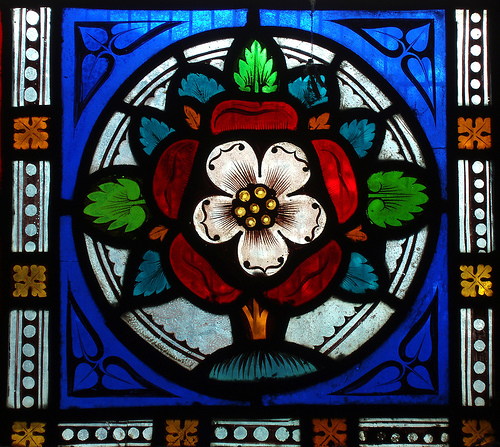
Tudor Rose Window. Source.
  • Character Maps

Also known as "French Scenes," these maps track each character's trajectory throughout the course of the play. This helps me build Character Tracks to assign to each individual actor, as I can see how the roles can conceivably double up. Luckily, since we have already produced 1, 2, 3 Henry VI and Richard III, we already have maps for these shows complete. I reorganized the doubles based on the concept for this project, but I didn't have to start from scratch. Henry V is also already complete, and we just finished Richard II yesterday.
To Do: 1 & 2 Henry IV

  • Casting Matrix

You can view the Casting Matrix for the first part of The Kingship Cycle and get an idea for how complex this project is! I have only just begun the Matrix for Part Two, but I won't be able to complete it without the aforementioned Character Maps. What makes this project particularly difficult to map is that I want individual actors to follow a character through multiple plays. For example, Falstaff appears in 1 & 2 Henry IV, and therefore the same actor will play Falstaff in both plays. Exciting stuff! But it can be messy when building the Matrix. I learned last weekend that it's better to start from the end and work backwards. The Richmond / Edward double in Richard III is clear from the Map, so that meant Edward and Richmond double in 3 Henry VI. OK, no problem, but where I had Edward placed in 2 Henry VI (in which he speaks only 1 line) didn't work at all. I had to unravel and re-do the Matrix three plays back. Now I know! I will start from Henry V and work backward!
To Do: R2-HV Matrix

  • Scripts

When Patrick and I prepare scripts for performance, we begin with the First Folio. I love the Applause texts of the individual plays. Neil Freeman's notes are terrific. He marks alterations between the various Folio and Quarto texts and describes in detail the changes that appear in each iteration. In our scripts, we preserve First Folio capitalizations and punctuation always, and spelling sometimes. Decisions on alterations to the line are discretionary, and sometimes I will make a note in our script so an actor can see the change and make the decision for themselves. Here's a peek into how different the versions can be. When we first started producing Shakespeare IN THE RAW, though, we had not yet developed this method. So our early scripts are ... well ... kind of a hot mess. I'm currently going through and re-setting the format, fixing typographical errors, and adding footnotes. I won't lie, it's kind of tedious. And there's a giant ticking clock ... the actors are going to need these scripts just as soon as possible. The actor who will be playing Richard III will have approximately 1900 lines to learn. To put that in perspective, an uncut Hamlet speaks 1476 lines. Yeah! What?!?
To Do: Formatting and editing for 1 Henry VI. Light editing for 3 Henry VI and Richard III.
Footnotes for 1, 2, 3 Henry VI, Richard III, Henry V
Everything (!) for Richard II, 1 & 2 Henry IV

  • Auditions

Right! I have to cast these shows! Because the actors playing Richard III and Henry V in particular have such a massive line load, I need to cast and get these scripts out so they have time to actually learn all these lines and prepare these intricate characters. That means auditions have to happen soon! So -- any actors reading this blog, this is for you! -- I'm planning to hold auditions for Part 1 of The Kingship Cycle on Sunday, April 1 and for Part 2 of The Kingship Cycle on Monday, May 14. You can send me your interest at casting@adkshakes.org now, but I'll also be emailing a notice to our Actor Mailing List. (If you're not on that and you want to be, email info@adkshakes.org.)
To Do: Actor Info Sheets and Sides from all eight plays.

  • Calendar

We have come up with a schedule for these rehearsals and performances. It's intense, and I love it! I'm planning a series of weekly workshops leading up to our intensive Shakespeare IN THE RAW style of rehearsal and performance. These workshops will include read-throughs, movement rehearsals, discussions on the genealogy, history, and socio-political issues in the plays. The rehearsals will be set up to put up two plays over the course of a weekend (as we have done in the past with the Bookend and Justice Projects) and then perform the same two plays the following weekend. Weeks 3 and 4 will be putting up and performing (twice each) the second two plays. And Week 5 (my favorite!) will be a marathon of all four plays. This week we have a meeting to ensure that we can hopefully get the specific dates we are looking at -- keep your fingers crossed!
To Do: Reserve all dates for workshops, rehearsals, and performances.

  • Research

This is just an ongoing piece of the puzzle. I am fortunate to be doing a portion of this work as my directed research for the spring semester. It's fascinating reading, and it's great exercise for my brain. I can't wait to dig into more reading on the law and history of the period. I'm swimming around in the first tetralogy of plays right now and also looking forward to diving into the second tetralogy.

Even though this To Do List is big and long and complicated, it's a wonderful feeling to realize that there's nothing else I'd rather be doing.

Wednesday, October 12, 2011

Kings as epic heroes, heroes of tragedy

For my Theory of the Novel class, I'm reading some excerpts by Georg Lukacs and came across this snippet which jumped out at me:
Epic heroes have to be kings for different reasons from the heroes of tragedy (although these reasons are also formal). In tragedy the hero must be a king simply because of the need to sweep all the petty causalities of life from the ontological path of destiny -- because the socially dominant figure is the only one whose conflicts, while retaining the sensuous illusion of a symbolic existence, grow solely out of the tragic problem; because only such a figure can be surrounded, even as to the forms of its external appearance, with the required atmosphere of significant isolation. (192)
No time to really do any thinking on the screen here about this quotation, but I didn't want it to get lost in my giant book. So I'm tagging it in a post here for later consumption.

Just curious -- anyone else out there using scholarly blogs for note-taking on larger research projects?

Above quote excerpted from The Theory of the Novel: A Historico-Philosophical Essay on the Forms of Great Epic Literature. in Theory of the Novel: A Historical Approach, ed. Michael McKeon. John Hopkins University Press, 2000.

Friday, September 2, 2011

Richard II: Reading List

I love the excitement of beginning a new project. Research is something I enjoy doing (yes, I'm a big dork).

This project has been percolating for some time. Back in January, I was already thinking ahead to a possible dissertation project. I used my Medieval Romance class in the spring semester to think about the nature of kingship, which was often periphery but nevertheless important in the various romances we read. My final paper in that class considered how the nature of kingship is closely tied to genealogy and kinship and is set in tension against foreignness or otherness. Here's my introduction to that paper (which I quite like!):


In the Alliterative Morte Arthure, the anonymous poet offers an incredibly complex presentation of King Arthur. There is tension in the poem surrounding the figure of the king in terms of kinship, most especially evident in Arthur’s relationships with Mordred and Gawain, but also in his genealogy and claims to rule in Britain and in Rome. In addition to the poem’s attention to close familial relationships, it is also troubled by an element of foreignness, or otherness. We see these troubling elements in Mordred’s foreign allies and mercenaries, as well as in the giant of Genoa whom Arthur battles on St. Michael’s Mount. I would like to suggest that Mordred and the giant are set up as particular foils of Arthur, representative of foreign elements, as Others in the text. Mordred is nephew to the king, and there are also clear parallels between the giant and Arthur in the text. In light of the parallels between these othered figures and Arthur, I would like to argue that the figure of Arthur in this poem embodies a tension between kingship and otherness. We see Arthur as a king who is simultaneously an individual body, with kinship ties, and a more expansive figure whose individual bloodline has greater importance as the bloodline of a nation. If the king’s bloodline or kinship is corrupted, or indeed if the king himself is Other, there is a present danger for the identity of the nation. First, I will establish the prevalence of textual concern with royal lineage and genealogy in the poem, moving forward to consider Arthur’s close blood ties with living kinsmen. I will then move to establish that, against this reading of kinship, there is tension regarding otherness and foreignness, even in the royal personage of the king himself. Arthur’s self-destruction and active reconstruction of an Other identity is significant in our reading of this text, as the figure of Arthur  therefore challenges established notions of kingship and sovereignty.


This was a pretty interesting paper in its own right. Part of its purpose was to whet my appetite for considering kingship -- would I find myself uninterested? Or (as I hoped and suspected) would I simply become ravenous for more? My Amazon wish list confirms this suspicion.

So now, I go forth into considering the Big 8 histories by Shakespeare and just what is it he is trying to say about kingship in these plays. At the moment I am dipping my toes into the various resources in English history and in literary criticism and in Shakespeare's source material and in anthropological studies on kingship and theatre practitioners' journals and commentaries. Oh forget dipping my toes ... I'm just diving in and going swimming in it.

Portrait of Richard II,
Westminster Abbey
This Monday, I'm having coffee with my friend Collin (my partner in kingship!) and we are specifically discussing Richard II. I'm very happy to start with this play, even though in the chronology of Shakespeare's writing it's right smack in the middle of these histories. Chronologically in terms of rule, however, Richard II comes first. I'm so intrigued to compare the historical record with Shakespeare's dramatization and see exactly what Shakespeare is doing with his dramatization. Here's where I'm starting with my reading list. If you have any suggestions, feel free to post them in the comments section!

  • The Life and Death of King Richard the Second, William Shakespeare (duh!)
  • Narrative and Dramatic Sources of Shakespeare Vol III: Earlier English History Plays, "Richard II," Geoffrey Bullough, ed.
  • The Meaning of Shakespeare Vol 1, "Richard II," Harold C. Goddard
  • The King's Two Bodies: A Study in Mediaeval Political Theology, "The Shakespeare: Richard II," Ernst H. Kantorowicz
  • Shakespeare's English Kings: History, Chronicle, and Drama, "Richard II: The Fall of the King," Peter Saccio
  • Shakespeare's Kings: The Great Plays and the History of England in the Middle Ages: 1337-1485, "The Young Richard," "Favourites and Appellants," "The King's Revenge" and "The Triumph of Bolingbroke," John Julius Norwich
  • Shaping the Nation: England 1360-1461 (New Oxford History of England Series), Gerald Harriss
  • "Richard II and the Vocabulary of Kingship," Nigel Saul, The English Historical Review, 1995
That should do for a start.

Wednesday, January 26, 2011

Thinking Ahead

In these early years of ADK Shakes's growth, it's a trial to figure out the seasonal rhythm. I feel like I need to be thinking a whole year ahead (or more) -- constantly. As soon as we closed our first summer season last August, I was already thinking ahead to Summer 2011. The Bookend Project goes up in just a few weeks, so of course I am thinking about our entire 2012 season and beyond.

What I love about being in school at the same time as being helmsman for choosing an ADK Shakes season is that I have the opportunity to delve into problems and questions both as a scholar and a theatre practitioner. The Bookend Project has been a consideration largely of violence and revenge. How do these things change over the course of Shakespeare's career as a playwright? Obviously this is a Bookend Project, so I only have the opportunity to stage the bookends of his career.  Someday I hope to consider the whole arc with more of the "middle"-- Hamlet, Othello, Much Ado, etc.

At the moment, however, I think I'm going to jump ship from the primarily revenge-oriented question. I am just not sure I want to spend the next decade with it. I am already thinking in terms of a dissertation project -- which will definitely take up (at least) the next decade of my life! What do I want to spend the next 10 years living and breathing and sleeping and eating and thinking about constantly? A revenge project would be pretty cool. But I'm not ready to commit. Sorry, revenge.

Battle of Agincourt.
Henry V = Ultimate King?
In the very broadest of terms, I am thinking about gender relations (in which cross-gender casting will figure heavily), power and politics, and the nature of kingship (which incidentally is also a big question in my Medieval Romance class -- probably more on that throughout the semester). At some point, I also want to begin looking outside the works of Shakespeare alone and possibly outside the Early Modern/Renaissance period. For this reason, I'm really excited to delve into the question of kingship in my Medieval class. I'll be reading around in a lot of Arthurian Romance and thinking about Arthur as the ultimate king.

I won't leave you without another plug for the Bookend Project. There's buzz going around the St. John's campus -- and St. John's students get in for FREE with their Storm Card. So to my theatre-going public, reserve your tickets now for $12 at adkshakes.ticketleap.com. Otherwise, it's $15 at the door! Don't miss it! And of course, come February 27, it will be full steam ahead towards Summer 2011.
Related Posts Plugin for WordPress, Blogger...